Conflict: the costs of inaction
Understanding the three phases of conflict: what donors need to know.

Civil society organisations (CSOs) are on the frontlines of justice, equality, and democracy. They are the drivers of change. Yet, beneath the surface of their missions, conflict often festers—and when left unmanaged, it quietly drains resources, weakens impact, and even threatens organisational survival.
Every meaningful relationship experiences conflict. According to research by John Gottman, 69% of relationship problems are perpetual, meaning they are never fully resolved. What is critical is learning techniques to manage discord by holding courageous dialogue and making amends. But most conflicts in CSO last over 2 years, and 82% of respondents to an extensive survey of civil society leaders stated that rebuilding trust in the aftermath of a conflict was a long and challenging process, often taking years. This stark reality is indicative of the lack of skills or time and attention given to the resolution.
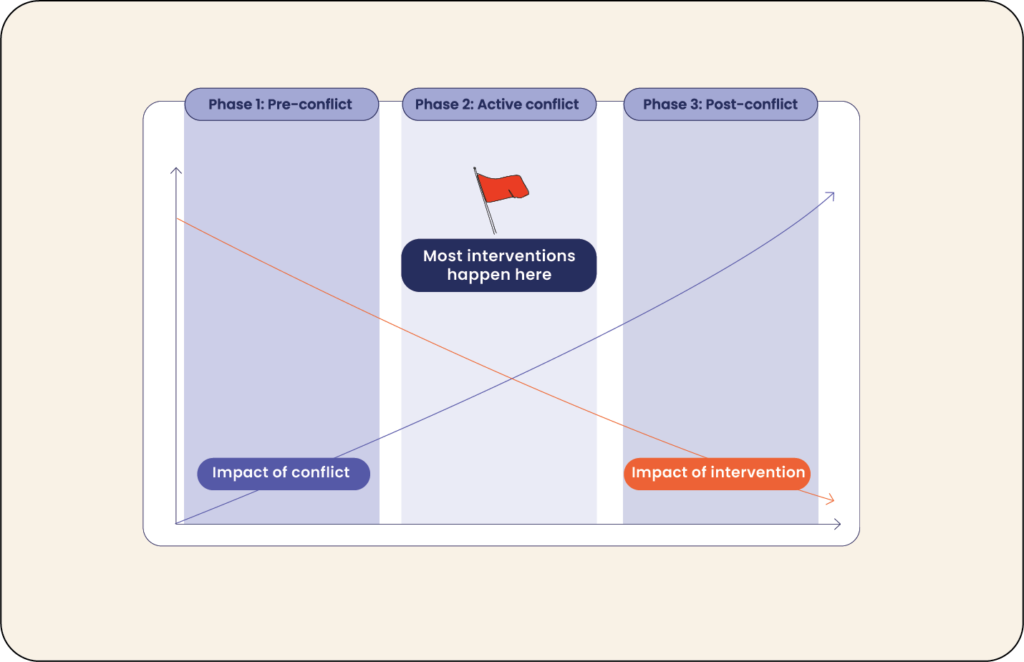
In our experience of having worked with in various resolution processes we see 3 key stages of conflict.
Pre-conflict – the illusion of unity
In the early stage, tensions are already present, but they are masked by false harmony. Teams and partners avoid raising difficult issues for fear of disrupting solidarity. MoUs may lack clarity, and power imbalances between large and small organisations, and between Global North and Global South allies, often remain unspoken
Typical signs:
- Unspoken concerns about roles, capacity, or direction
- Lack of clarity in agreements
- Power imbalances between partners
- Surface-level cooperation but little genuine trust
This is the moment when learning conflict resolution protocols and gaining the capacity to navigate difficult conversations can build harmonious regenerative work spaces. Intervening here sows the seed for greater creativity and sets CSOs up for thriving and resilient collaboration.
Active conflict – frustration surfaces
When early warning signs are ignored, conflict becomes corrosive. Individuals retrench in their positions, blame takes root, and collaboration breaks down. Staff may feel powerless, while organisations expend enormous energy navigating internal battles rather than advancing their mission.
Typical signs:
- Inflexibility underpinned by identity or commitment to ideological purity
- Loss of agency and morale among staff
- Covert resistance or alliance-building that undermines trust
- Diminished organisational capacity and reputation
By this stage, programmes may be directly undermined. Most interventions in the corporate sector happen here, when relationships are already fraying. At this stage, team detox processes, mediation, coaching, and governance strengthening can help contain the damage and rebuild capacity for greater solidarity.
Chronic or late-stage conflict
When long-simmering conflicts are left unresolved for years, it calcifies into dysfunction. Burnout and turnover spike, reputations suffer, and organisations risk mission failure. At this point, entire movements can be weakened, providing openings for regressive forces to exploit division.
Typical signs:
- Persistent resentment and disillusionment
- Long-term sick leave and staff attrition
- Reputational harm
- Weakening of movement and credibility
At this point, the resources invested are at risk — not because the cause lacks merit, but because internal conflict has hollowed out the organisation’s ability to deliver. Often, the goal at this stage is to ensure a dignified and respectful exit of people and safeguard the organisation’s reputation.
What donors can do
As stated above, most interventions in the private sector happen in Phase 2 in an effort to salvage the effectiveness of a team. In civil society, however, the strong sense of individual identification with the organisation’s mission leads people to drive forward despite chronic conflict. The shadow effect of this is that appropriate action is not taken in good time. In this context, the passion that is civil society professionals’ greatest strength can become their weakness, as they persevere, often exacerbating harm. As demonstrated by the Civil Society Conflict Survey, conflicts in the sector tend to be prolonged and the majority last for more than two years.
What can be done:
- Early interventions: The most effective time to address conflict is Phase 1, i.e. Pre-conflict. This helps people build capacity to hold crucial conversations with challenge and care, and deploy conflict management strategies to be more effective leaders.
- Foster openness and provide flexible support: Conflicts left unaddressed quickly become corrosive. CSOs need access to professional conflict resolution services as early as possible.
- Convene parties and organisations: Where possible, movement elders or donors can act as convenors, bringing those in conflict together