The impact on individuals
Many CSOs are struggling with a quiet crisis: pervasive internal conflict is eroding human relationships and well-being.

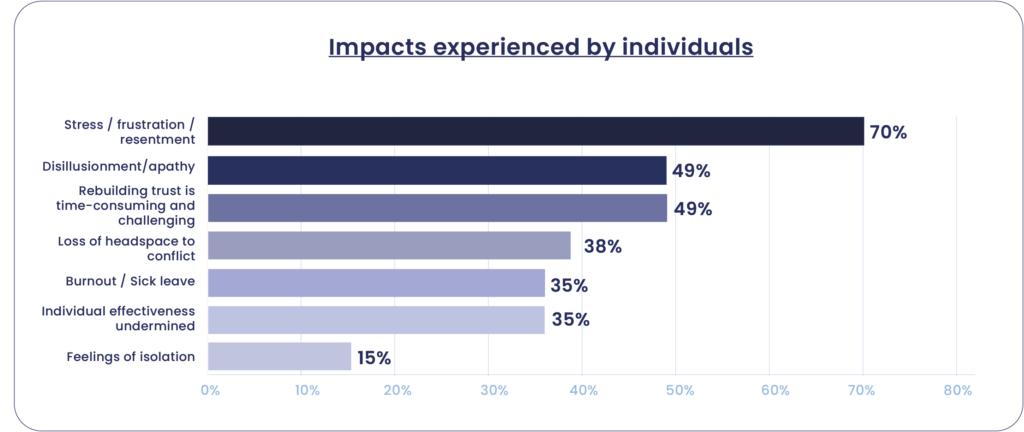
Extensive research conducted by Cause and Conflict with civil society leaders demonstrates that conflict exacts a heavy toll on the individuals who make up this sector and, in many cases, jeopardises their missions. Survey data from over 40 civil society leaders across the Global North and South revealed that more than 70% experienced stress, frustration, or resentment as a result of internal conflict. Many also described feelings of isolation, disillusionment, or apathy, with some forced to take extended sick leave due to the strain.
Unlike in the corporate world, where conflict is often treated as a management issue, in CSOs it frequently cuts to the core of personal identity. As sociologist Amitai Etzioni observed, civil society professionals often derive a deep sense of self from their work. When relationships break down, it doesn’t just affect job satisfaction—it shakes one’s sense of purpose and belonging.
Strife without end?
One of the most striking findings of our research is the longevity of conflicts in CSOs. Over 40% of survey respondents reported disputes lasting more than a year, and some described conflicts dragging on for three to five years or longer. In many cases, resolution only came when one or more individuals left the organisation—hardly a healthy or sustainable outcome.
Several structural and cultural features of civil society make individuals particularly vulnerable to becoming bogged down in conflict. Limited resources, high expectations of ethical consistency, and a commitment to horizontal decision-making often combine to leave staff ill-equipped to handle disagreements. A lack of safe, structured resolution processes, meanwhile, means that conflicts tend to fester rather than heal.
The overwhelming consensus from survey respondents was that conflict within NGOs and social movements, both internally and externally, is pervasive and profoundly damaging to well-being.
Moreover, when organisational values are contradicted in practice—for example, when inequitable power dynamics or neo-colonial leadership patterns persist—the psychological impact on staff is acute. Many professionals describe the dissonance between mission and reality as profoundly demoralising.
As one survey respondent reported: “I have seen countless examples of organisations not practising what they preach and a belief, in upper management in particular, that the fact that they are non-profit means that people need to put up with bad behaviour”
The consequences of unresolved conflict on individuals—stress, burnout, isolation, and loss of purpose—cannot be treated as “collateral damage.” They undermine not only well-being but also the effectiveness of organisations and movements. As one survey respondent put it, “repairing internal relationships must come before external work.”